


Source: C.E. Brock, 1895 (public domain)

If you’re a fan of Jane Austen’s Pride and Prejudice you probably love the heroine, Elizabeth Bennet, admire the hero, Mr. Darcy, and detest the villain, Mr. Wickham. And if you’re like most who read about him in the novel or see him portrayed in any of its numerous screen adaptations, you almost certainly despise the pompous clergyman, Mr. Collins.
Poor Mr. Collins! With the possible exception of Lady Catherine de Bourgh, he is probably the most universally disliked character in the entire novel. Even Wickham may not be as detested by readers: although he became, in effect, a child sex abuser when he ran off with 15-year-old Lydia Bennet, at least Wickham has charm, which Mr. Collins definitely does not!
Elizabeth Bennet despises Mr. Collins and rejects his proposal of marriage with disdain. But is he really what she thinks he is: an obnoxious buffoon with no redeeming qualities, whom no woman of sense could possibly want to marry?
I think there’s another side to Mr. Collins’ story that most readers have overlooked. So, in this article, we want to challenge the prevailing exclusively negative view of Mr. Collins and shed some light on why he may not be as bad as he seems.
Note: I’m assuming that readers of this article are already familiar with both the events of the novel and the Mr. Collins character; so, there will be spoilers!
Why We Think Mr. Collins Is So Bad
From the moment we first meet the Rev. William Collins in Chapter 13, the deck is stacked against him. First, Jane Austen herself, in her persona as the all-knowing, not-to-be-doubted narrative voice, tells us that:
Mr. Collins was not a sensible man, and the deficiency of Nature had been but little assisted by education or society.
She describes him as weak-headed, conceited, inordinately proud of his position and authority as a clergyman, and “altogether a mixture of pride and obsequiousness, self-importance and humility.”
Later, in recounting his proposal to Charlotte Lucas, Austen says of him,
The stupidity with which he was favoured by nature must guard his courtship from any charm that could make a woman wish for its continuance
Elizabeth Bennet’s negative opinion of Mr. Collins was formed before she even met him. After hearing her father read the letter Mr. Collins sent to the Bennet family announcing that he was coming for a visit, Elizabeth asked, “Can he be a sensible man?”
Her impression that he was not sensible was confirmed by her father’s gleeful reply, “No, my dear; I think not. I have great hopes of finding him quite the reverse.”
After turning down Mr. Collins’ proposal of marriage herself, when Elizabeth learned that he had been accepted by her best friend, Charlotte Lucas, she could hardly contain her loathing both for the man and for the very idea of any sensible woman wanting to marry him. She was so disgusted, in fact, that she even became annoyed with the elder sister she adored when Jane refused to join her in trashing Mr. Collins:
“My dear Jane, Mr. Collins is a conceited, pompous, narrow-minded, silly man: you know he is, as well as I do; and you must feel, as well as I do, that the woman who marries him cannot have a proper way of thinking. You shall not defend her, though it is Charlotte Lucas.”
Not only does Jane Austen herself explicitly tell readers how awful Mr. Collins is, she clearly intends for us to share the contempt Elizabeth feels toward him.
“Not Sensible, Stupid, Conceited, Pompous, Narrow-Minded, Silly”. That’s how Mr. Collins is described in Pride and Prejudice
Is Mr. Collins Really as Bad as He Seems?
Yes… and no.
The things Mr. Collins does and the way he carries himself often show him in a very negative light, but even those instances may not be as bad as they seem on the surface. Let’s take a look:
The Bad, the Unwise, and the Ugly
- His proposal to Elizabeth was a pre-scripted monologue in which he starts by saying he wants to marry her because (1) it’s his duty as a clergyman, (2) it will make him (not her) happy, and (3) Lady Catherine told him to get married. His presentation was a masterpiece of pomposity, conceit, and (when he refuses to take Elizabeth’s rejection seriously) willful self-deception. [Chapter 19]
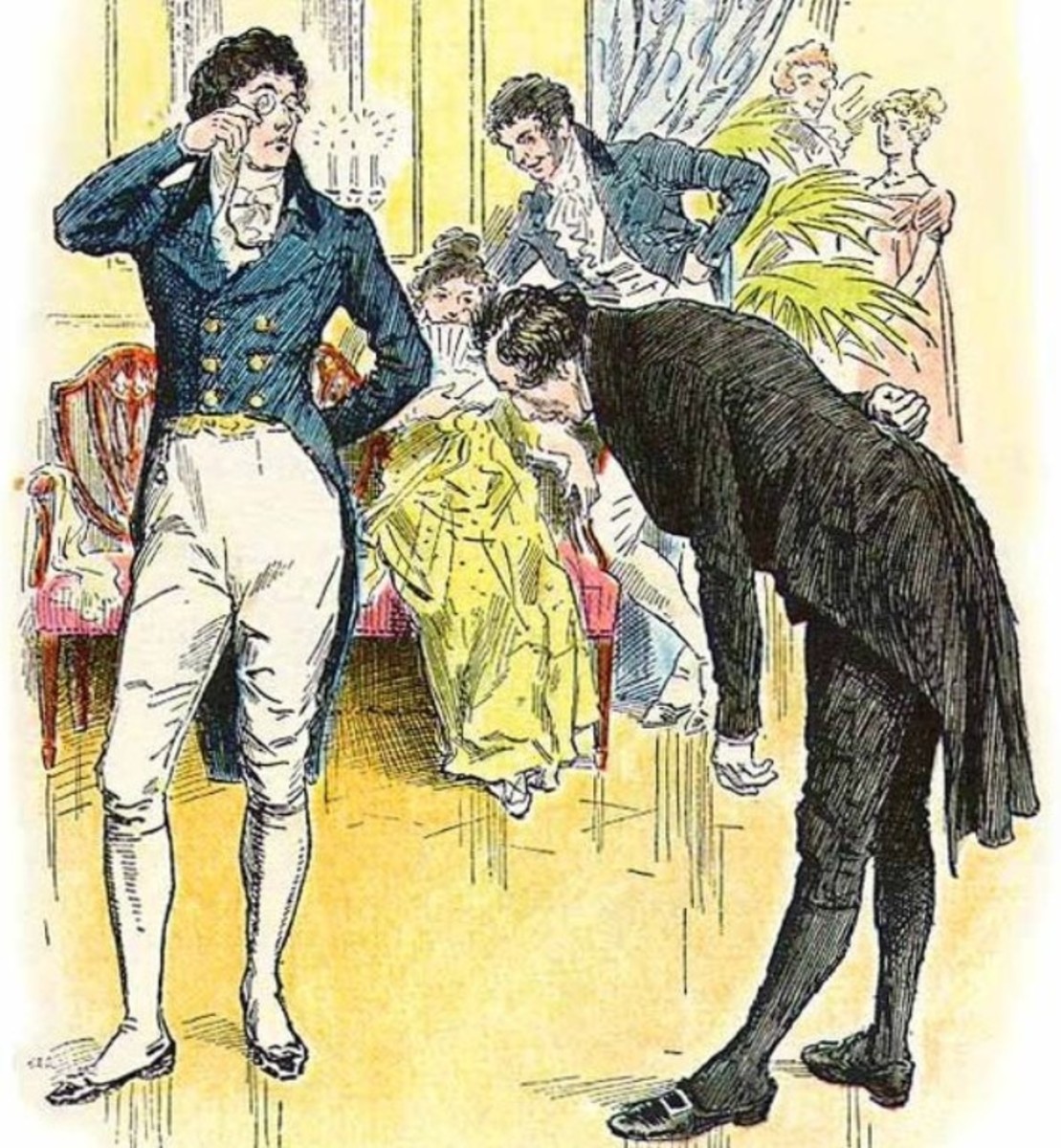
- His lack of self-awareness was embarrassingly displayed when he introduced himself to Mr. Darcy at the Netherfield ball, ignoring Elizabeth’s earnest warning “that Mr. Darcy would consider his addressing him without introduction as an impertinent freedom.” By doing so, he violated the deeply ingrained social convention that a person of lower status must never intrude himself or herself unasked upon the notice of someone of higher status. Darcy’s reaction was one of astonishment and icy contempt. [Chapter 18]
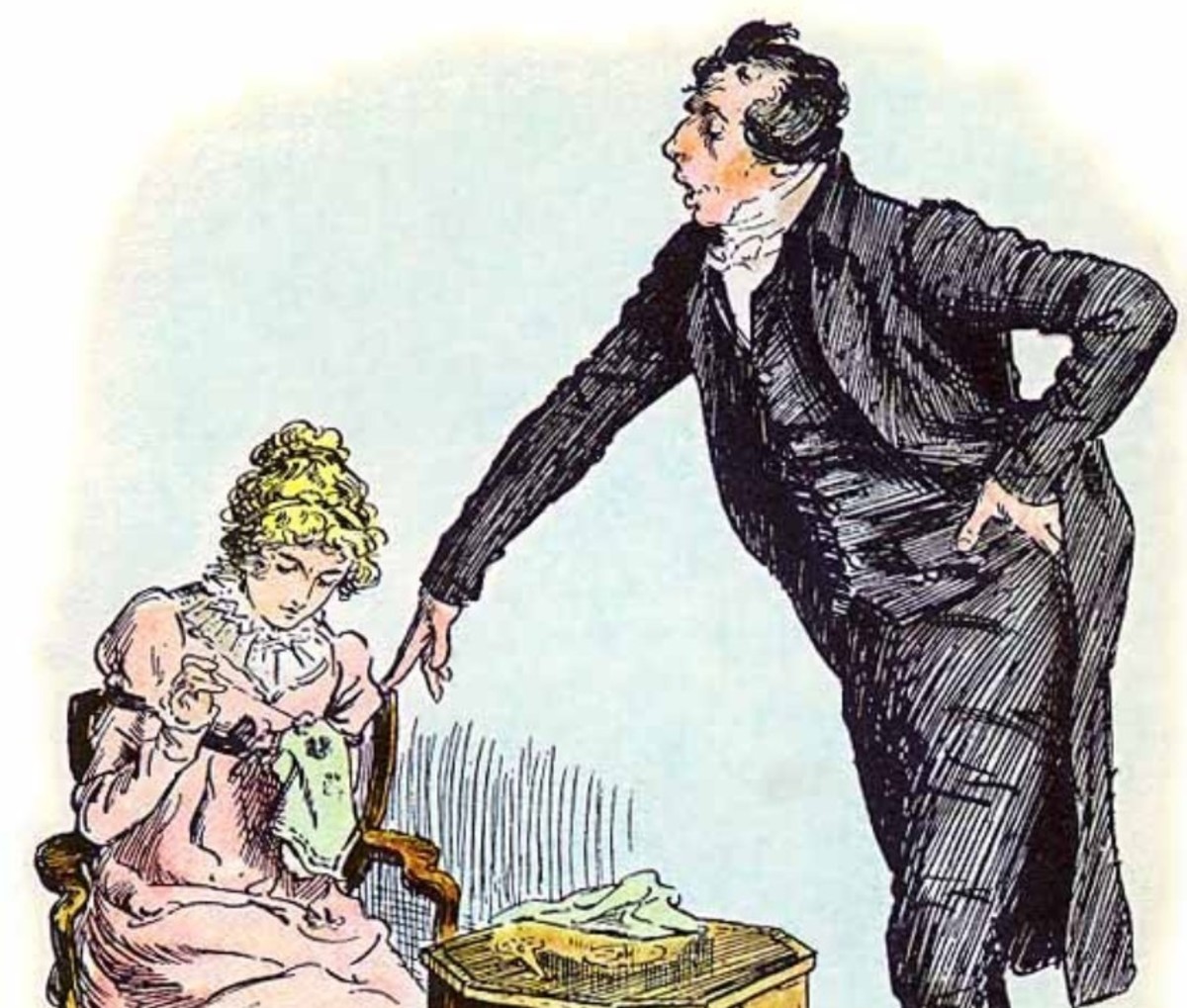
- The letter he sent to “condole” with the Bennet family after Lydia ran away with Wickham seems downright cruel: his idea of comforting them is to assure them that Lydia’s downfall is a disgrace “which no time can remove” and for which “the death of your daughter would have been a blessing in comparison.” [Chapter 48]
Source: C.E. Brock, 1895 (Public Domain)

On the other hand, there’s a case to be made that these instances aren’t really as utterly reprehensible as they at first seem:
The Less Bad, the Justifiable, and the Bad but Understandable
- Mr. Collins’ proposal to Elizabeth was arguably less objectionable than Mr. Darcy’s. While Mr. Collins was pompous, Darcy was downright insulting. He started by telling Elizabeth how hard it was for him to overlook all the horrible social and behavioral defects of her family, apparently thinking she would be flattered by his making the sacrifice of wanting to marry her despite them.
Both men were pridefully overconfident in their proposals: Mr. Collins assumed Elizabeth would accept him because of his position as a clergyman and because by marrying him, the heir to the Bennet estate, she would prevent her mother and sisters from being kicked out of their home when Mr. Bennet died.
But Darcy, having never received any sign from Elizabeth that she even liked him, apparently thought she’d be overjoyed to get him because his social status and wealth made him a great catch for any woman. He was, therefore, even more astonished, wounded, and angry than Mr. Collins when she turned him down.
- Mr. Collins felt himself justified in approaching Darcy because, as he said, “I consider the clerical office as equal in point of dignity with the highest rank in the kingdom.” And he was right: Church of England clergymen were expected to provide spiritual guidance to parishioners regardless of social status. Mr. Collins told Elizabeth he considered it his duty to establish contact with the nephew of Lady Catherine, the most high-profile member of his parish.
In this encounter, Mr. Collins again comes off better than Darcy. The fact that Elizabeth believed, based on her observation, that Darcy did not display any “irreligious” habits indicates that according to expectations in that society, he was a church-going, professing Christian. Humility is one of the highest of Christian virtues (e.g., “Be completely humble and gentle” – Ephesians 4:2). So, for Darcy to coldly disrespect a clergyman simply because he considered himself to be of higher social status paints Darcy in a far more negative light than Mr. Collins. - Mr. Collins’ “condolence” letter comes across today as unfeeling and judgmental—it certainly falls far short of the ideal of Christian charity. Yet, in almost celebrating the retribution he expected to fall on Lydia’s head, Mr. Collins was giving voice to what would probably have been the common reaction in that time.
For example, Austen, as the narrative voice, reports that the “spiteful old ladies in Meryton” thought it would be a just outcome if Lydia had been forced to “come upon the town” (that is, become a prostitute). Even after her marriage to Wickham foreclosed that pleasant prospect, they still rejoiced that “with such a husband her misery was considered certain.”
So, although Mr. Collins’ pitiless attitude toward Lydia was certainly inhumane, it was not an indication of some unique flaw in his character—he was expressing out loud what probably most people who knew of Lydia’s fall from grace were thinking.
Source: C. E. Brock, 1895 via Wikimedia (Public Domain)

Mr Collins’ Positive Qualities
Not only are Mr. Collins’ negative qualities not necessarily as bad as they seem at first, but he also exhibits some positively good qualities that are often overlooked:
- Kindness – With his advantages (his position and status as a clergyman, the patronage of Lady Catherine de Bourgh, being heir of the Longbourn estate and its income of £2000 per year), Mr. Collins wouldn’t lack for eager aspirants (such as Charlotte Lucas) to become his wife. But because the Bennet estate was entailed to him, he intended to marry one of the Bennet sisters as an act of kindness to ensure that they wouldn’t lose their home when Mr. Bennet died.
- Gratitude – Mr. Collins was sincerely and vocally grateful for Lady Catherine’s patronage.
- Humility – Austen notes that Mr. Collins originally had great humility of manner. Although it had been a great deal counteracted by self-conceit, the underlying humility with which he was raised was still a fundamental element of his character.
- Politeness – Mr. Collins expressed to Darcy his conviction that as a clergyman, he should have “attentive and conciliatory manners towards everybody.” Although he often overdid it, he really tried to be polite to everyone.
- Good Character – With all his faults, Mr. Collins’ basic character is never questioned—he was often gauche but never vicious and consistently tried, however imperfectly, to do the right thing. Even Elizabeth, when his engagement to Charlotte was announced, had to acknowledge “the excellent character of Mr. Collins.”

Source: Author using AI
Mr. Collins Can Change!
More than anything else, Pride and Prejudice is about change: Elizabeth brings Darcy’s pride home to him, and he changes; she recognizes her own prejudice and changes. Well, if Lizzy and Darcy can change, why can’t Mr. Collins?
After all, he’s only 25 when we meet him—younger than Darcy. (The fact that he’s usually played by older actors in screen adaptations—David Bamber was 41 when he played Mr. Collins in the 1995 BBC series—often misleads viewers). Isn’t it likely that much of his social awkwardness, lack of self-awareness, and general silliness are outgrowths of his immaturity?

Scientists say that many people don’t mature into true adulthood until they’re in their 30s. Mr. Collins’ ideas and outlook on life are almost certain to change substantially as he gains more experience in life.
For example, when he proposes to Elizabeth and refuses to take her refusal seriously, Mr. Collins attributes her reaction to “the established custom of [women] to reject a man on first application” and thinks it reflects “the true delicacy of the female character.” Wherever he got that silly idea (at that point in his life, he had very little personal experience with women), it’s unlikely to survive even a few years of exposure to the real lives of the people in his parish.
One great thing Mr. Collins has going for him is that in Charlotte, he has a mature, grounded, and wise wife who knows how to guide him (or, to be honest, manipulate him) without him even realizing it. What he becomes later in life is likely to be significantly influenced by her.
Mr. Collins is a young man who still has a lot of learning, growing, and maturing to do. And when he does, I think he’ll become someone who, because of his fundamentally good character, is far wiser and significantly more likable than the buffoonish caricature so many readers love to hate.
© 2023 Ronald E Franklin