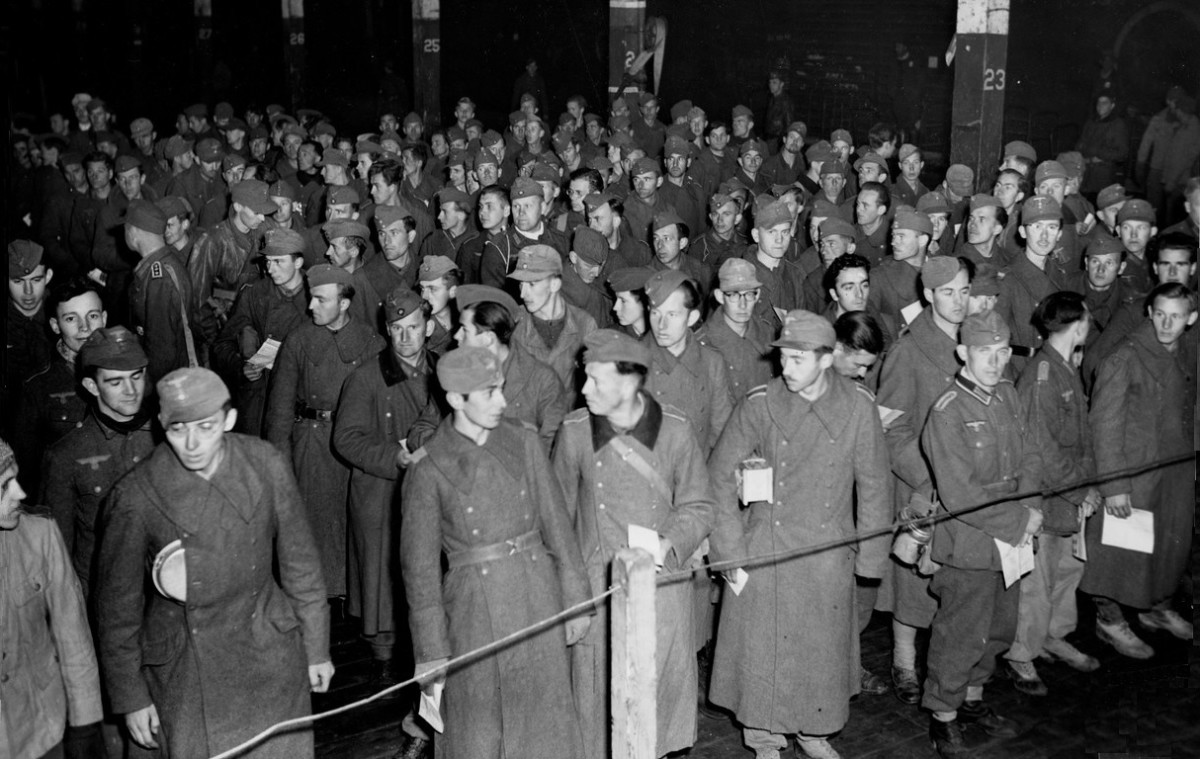
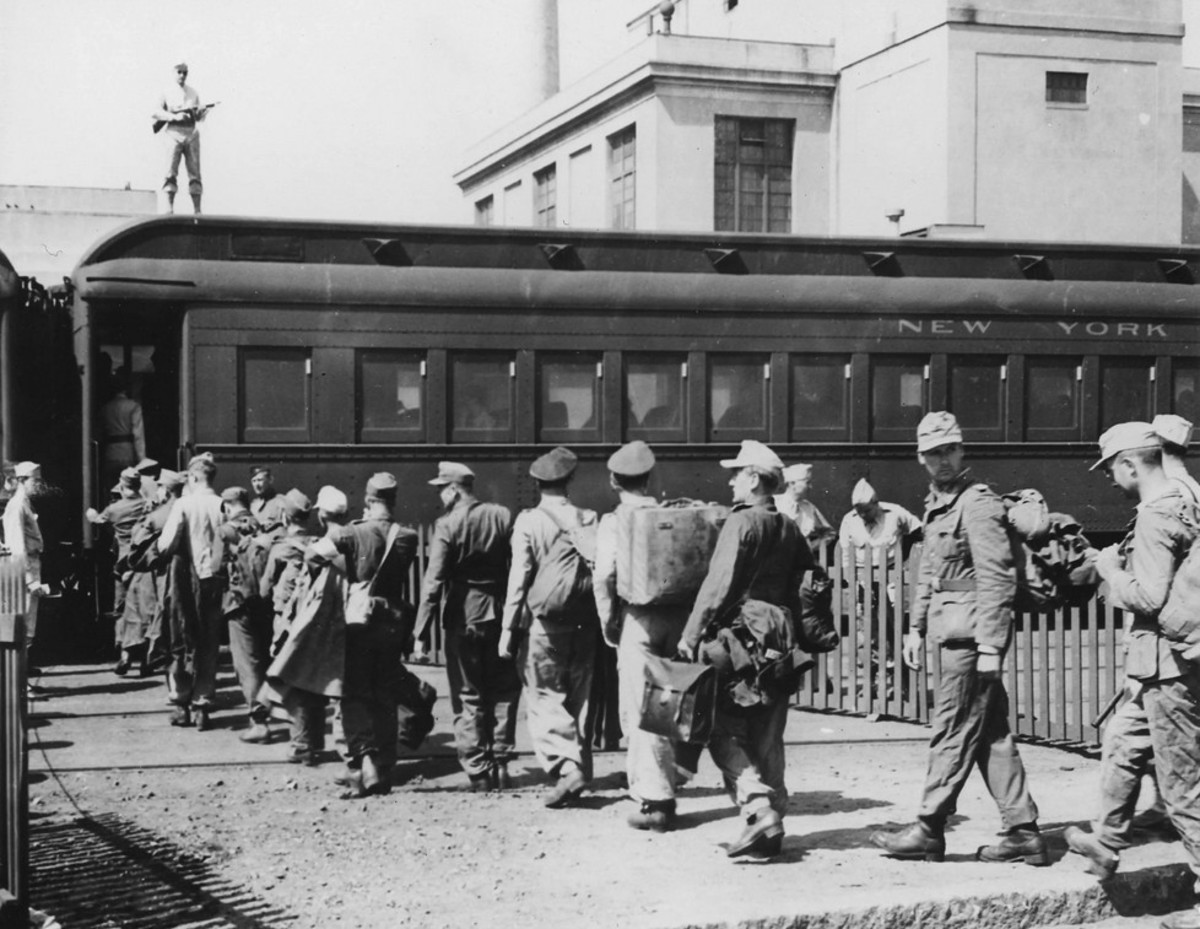
German POWs arriving at Newport News, Virginia, 1943 Source: U.S. Army Signal Corps, National Archives Identifier 138926202 (Public Domain)
Rommel’s Afrika Korps Comes to America
On June 4, 1943, residents of Mexia, Texas, witnessed a sight never before seen in their community. A troop of 1,850 uniformed soldiers marched confidently down the main street of the town. According to historian Arnold Krammer, the young men were tanned and healthy, and they marched with what he called a “defiant cadence.” [1]
Why defiant? These were not hometown boys reluctantly marching off to war. No, for these soldiers, the war was over. Their defiance arose from the fact that they were captured veterans of Field Marshall Erwin Rommel’s famed Afrika Korps and were now on their way to be housed in a newly erected prisoner of war (POW) camp where they would sit out the rest of the war.
However unusual this sight may have been to the inhabitants of Mexia, it was far from unique. During the remaining years of the war, it would be repeated hundreds of times across the U.S.
The U.S. Agrees to Accept German POWs
The surrender of the Afrika Korps to British and American forces in May of 1943 put 275,000 German and Italian troops into the hands of the Allies. [2] It was a great victory, especially for the British, but it brought with it a major responsibility.
When enemy fighters surrender, they don’t just disappear from the battlefield. Rather, they must be housed, fed, guarded, and protected by their captors. But the British, already suffering severe wartime deprivations in both food and manpower, were in no position to take on such responsibilities for more than a quarter of a million new prisoners.
So, they called on their American ally to assume the bulk of that responsibility. The U.S., which had never done anything like this before, reluctantly consented. As a result, Liberty Ships were soon crossing the Atlantic, bringing as many as 30,000 Axis prisoners of war to the U.S. each month.
By the end of the war, the U.S. would be housing 475,000 German POWs distributed across 700 prisoner of war camps around the country. [3]
Although food and manpower supplies were not nearly as constrained in America as they were in Britain, they were still a real issue. Many thousands of men were being drawn away from their previous occupations into either war production jobs or the military. As a result, by mid-1942, more than two million workers had left the nation’s farms, and the U.S. was suffering from a severe shortage of agricultural workers. [4]
At first, American authorities saw the influx of POWs as a potentially serious problem. They feared it might be the source of all kinds of disruptions, ranging from escape attempts to sabotage and even to violence by angry civilians outraged at the presence of a hated enemy.
The POWs Meet a Pressing Need for the U.S. Home Front
But as the domestic manpower shortage made itself felt more and more, U.S. officials began to see the POWs in a new light—as a possible replacement labor force for all those American workers who had been diverted into military service or war production jobs.
As the domestic manpower shortage increased, U.S. authorities began to see the POWs as a replacement labor force.
And according to the Geneva Convention, that was a perfectly appropriate strategy.
Requirements of the Geneva Convention
The Geneva Convention allowed combatant countries to use their POWs as workers. Officers (including non-commissioned officers) could not be required to work, though they could volunteer to do so if they wished. But soldiers below the rank of sergeant could be ordered to work. All that was required was that they not be forced to do jobs that were dangerous or directly related to the host country’s war effort and that they be paid equivalent to what a regular worker might earn.
So, the U.S. government established a work program that would provide POW labor for use where needed. Their pay was based on the $21 per month U.S. Army privates received and amounted to 80 cents a day for work done outside the prison camp and 10 cents a day for work performed inside the camp. Any prisoners who refused to comply with orders to work were put on bread and water until they did comply, which usually happened very quickly. [4]
POW workers were never paid in cash because it could be used to facilitate escape attempts. Rather, they were paid in scrip that could be used for purchases in the camp store or put into a savings account for payment after the war.
How the POWs Worked
With food rationing a hated but necessary fact of life in the U.S., increasing agricultural production was one of the nation’s highest priorities. So, although some prisoners did other types of jobs, most POW workers across the country were used as farm laborers.
They did everything from driving tractors or teams of horses to pulling weeds to harvesting the crops. And they did it relatively well. The only factor that sometimes limited their efficiency was faulty communication between farmers who spoke only English and POWs who spoke only German.
According to one prison camp’s commanding officer,
“Most of the Germans preferred hard, routine manual labor 10 to 12 hours a day. In many places we worked around the clock, two shifts 12 hours each.” [4]
How German POWs Were Treated By the Civilians They Worked For
POW workers were generally treated very well by the farmers who employed them. In fact, they usually were viewed more as normal laborers than as prisoners and often enjoyed personal relationships with the farm families they worked for. As the Washington Post noted,
Local people whose livelihood depended on German labor often doted on the workers, treating them to baked goods, inviting them into their homes, mending their clothes and generally welcoming them warmly. “They were just the best bunch of boys you ever saw in your life,” a Texas farmer gushed to Smithsonian.
Gerald Haas, who was 12 years old when his parents employed POW workers on their farm, recalls that:
“My family hired some prisoners to pull and cut weeds on our land… My mom always cooked and fed them their noon meal and as a result they worked very well for us.” [4]
Despite lax security, very few POW workers tried to escape.
Although every work crew was supposed to have a vigilant guard detail, things soon became so relaxed that security was practically non-existent. Yet very few of the prisoners tried to escape while on the job. Dick Norton recalls what it was like on his father’s farm:
“My father had hired a group of them to pull the cockleburs in the bean fields. The guard, I discovered when I took some cold soft drinks out to them, was asleep between the bean rows.” [4]
Less than 1% of POWs in the U.S. ever attempted to escape, a rate actually lower than for the civilian prison population. [3]
How the POWs Helped the U.S. Win the War
According to the Geneva Convention, the German POWs were not supposed to do work that directly aided the American war effort, but their efforts did exactly that, and to a substantial degree.
Without the increased food supplies the German POWs helped produce, rationing would have been an even more onerous burden for Americans, which would certainly have had an impact on homefront morale. Plus, every POW who went to work potentially released an American worker for service in the military.
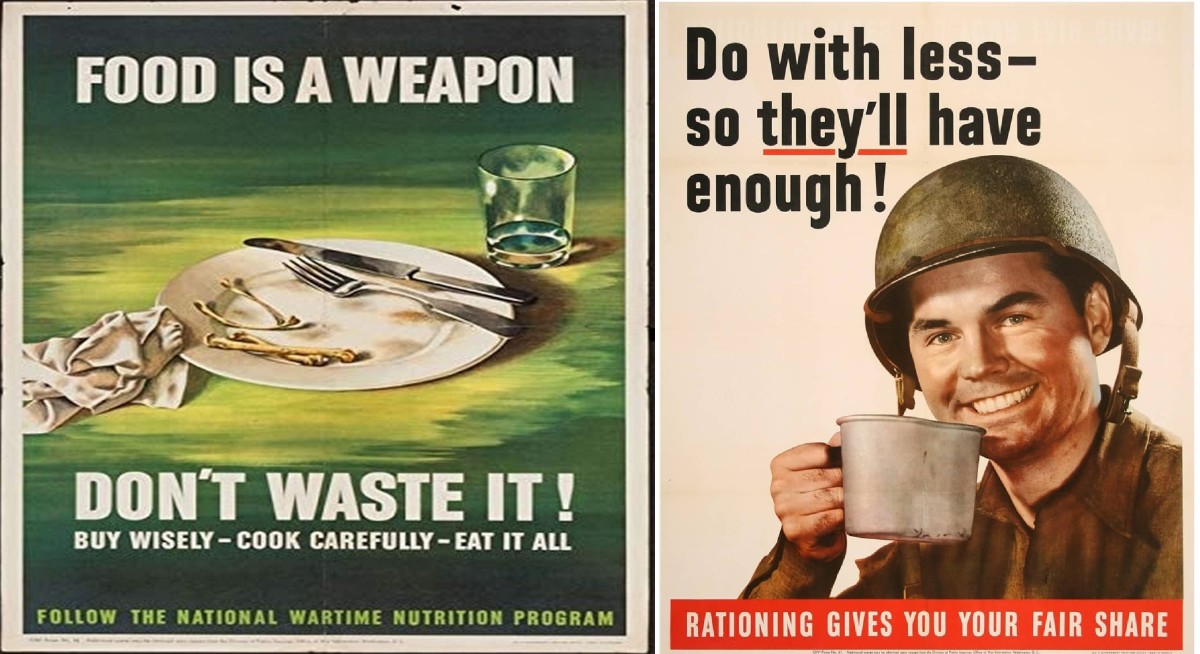
But there was an even more direct contribution the Afrika Korps POWs made to the U.S. war effort. As these posters by the Office of War Information indicate, increased food production was a major factor in the country’s ability to keep its soldiers at peak fighting efficiency.
Office of War Information food rationing posters #56 and #37 Source: U.S. Office of War Information (public domain)
Lt. Col. Arthur Lobdel, commanding officer at the Algona prison camp in Iowa, was unequivocal in his estimate of the positive impact of the POW work program on the U.S. war effort. [4]
“The work done by these prisoners increases production and helps shorten the war.“
— POW camp commanding officer Lt. Col. Arthur Lobdel