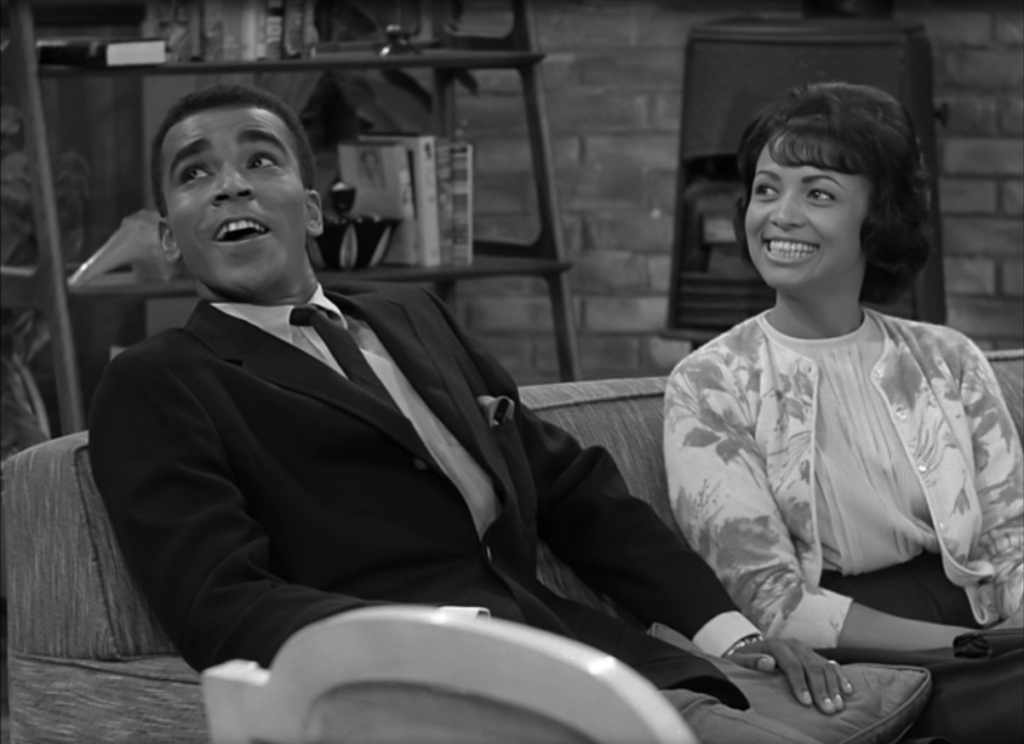
Greg Morris and Mimi Dillard breaking barriers on “The Dick Van Dyke Show,” September 25, 1963. Source: Video screen capture (Fair Use)
The Dick Van Dyke Show: A Standard of Excellence in an All-White TV World
The Dick Van Dyke Show was one of the most popular and well-loved programs of mid-20th century American television. It was also one of the whitest.
For the first half of its network television run, the show brought its audience into a world in which Black people, for the most part, simply didn’t exist. But when an African American couple finally did appear, they did so with a bang!
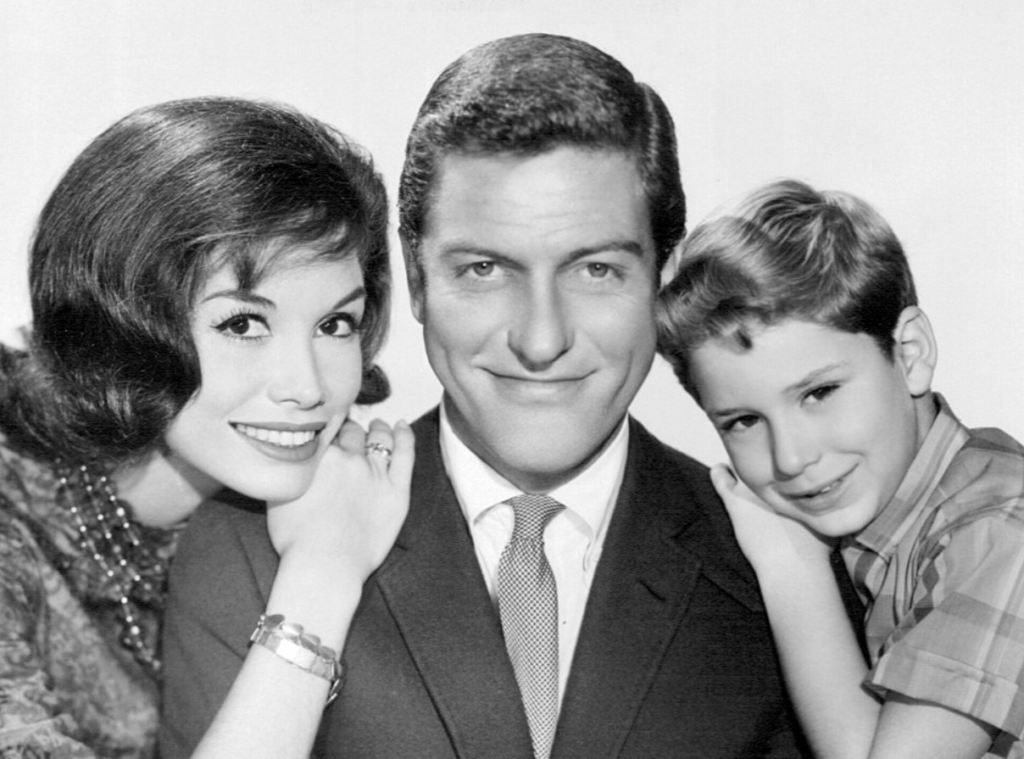
The series, which starred Dick Van Dyke as Robert Petrie and Mary Tyler Moore as his wife, Laura, reigned as one of television’s premier situation comedies from 1961 to 1966. During its initial run the show was nominated for 40 Emmys and won 15.1
Carl Reiner Ended Show on His Terms
After a somewhat rocky start (it was almost canceled after its first season, but caught on during summer reruns),2 the show maintained its popularity so well that it was never actually canceled. Producer Carl Reiner deliberately ended the show at the end of the fifth season. He wanted to go out on top before the writers ran out of ideas and started repeating themselves.1
And that popularity has not waned to this day. The Dick Van Dyke Show is still going strong in reruns.
The Petrie Family: Mary Tyler Moore as Laura, Dick Van Dyke as Rob, and Larry Mathews as Ritchie. Source: CBS Television via Wikipedia
The Show Was Exclusively White for First Two Seasons
The Dick Van Dyke Show’s main character, Rob Petrie, was the head writer for a fictional television variety program, The Alan Brady Show. That job allowed him, his wife Laura, and their son Ritchie (played by Larry Mathews) to live an upper middle class lifestyle in the prosperous New York City suburb of New Rochelle, NY.
For most of the run of the series the world the Petries inhabited, whether at home or at the Manhattan office Rob shared with fellow writers Buddy Sorrell (Morey Amsterdam) and Sally Rogers (Rose Marie), was almost entirely White.
In fact, if Martians had tried to learn about life on earth by watching the first two seasons of The Dick Van Dyke Show, they could be forgiven for reaching the conclusion that no such beings as Black people existed on the planet.
September 1963: African Americans Finally Appear on the Show
But that changed with the first episode of the program’s third season. In that show, which was broadcast on September 25, 1963, the Petrie family’s world was suddenly and spectacularly integrated by the appearance of an African American couple who were presented as being just as middle-class, prosperous, and attractive as the Petries were.
The fact that The Dick Van Dyke Show was effectively all White was not due to any deliberate racism, but was a reflection of what audiences in 1960s America would consider normal based on the upscale setting of the show and the social conventions of the time. Actually, according to Carl Reiner, the show’s production team were determined to find a way to break through that color barrier:2
We were always looking to get African Americans into the show, because it was such a white neighborhood, and I was very aware of those social problems that existed in our country.
— Carl Reiner, Dick Van Dyke Show producer/writer/actor
Origin of “That’s My Boy??”
They got their chance when two aspiring writers, Bill Persky and Sam Denoff, submitted a script for an episode called, “That’s My Boy??”
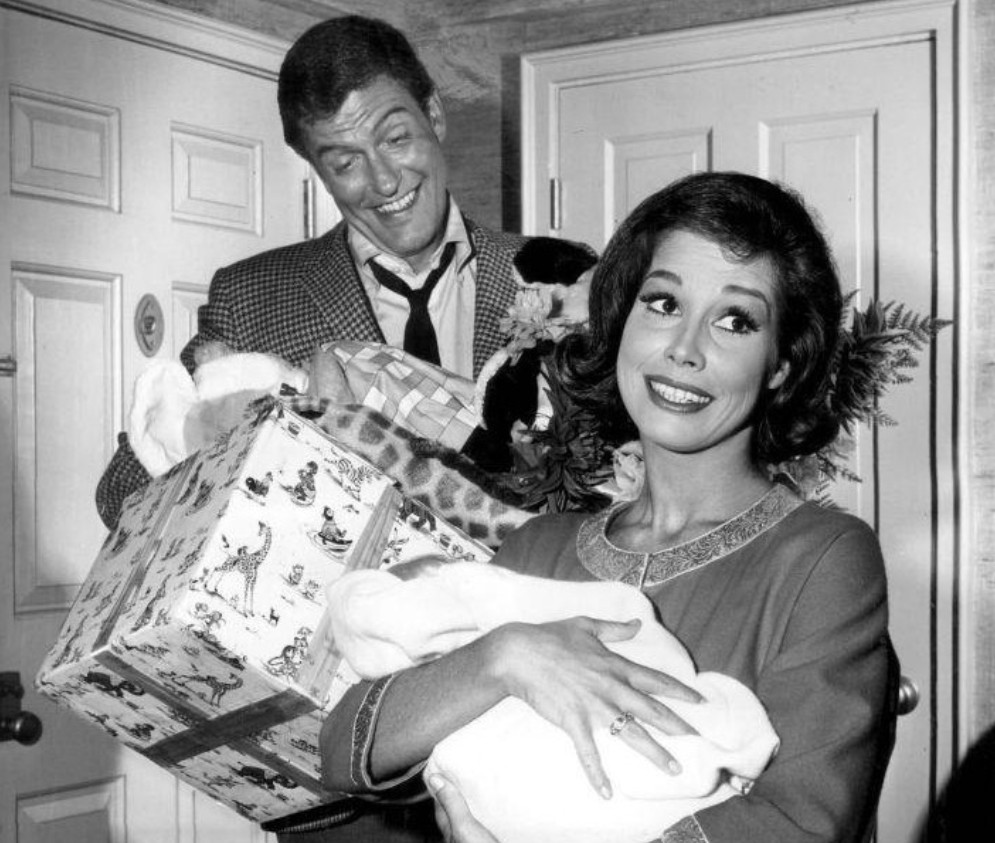
The comedic scenario of the episode (you can watch the video at the end of this article) was a flashback to the birth of the Petries’ son, Ritchie. After Rob brought Laura and the baby home from the hospital, several things occurred that made him begin to wonder if the hospital had given them the wrong child.
First, he thought the child didn’t look anything like either him or Laura. Then he remembered that the hospital had kept mixing the Petries up with another couple, named Peters, who had a baby the same day. Laura was in Room 208, while Mrs. Peters was in 203, and as the Petries were getting ready to leave the hospital, a nurse mistakenly called their child “Baby Peters.”
After finding that the hospital had erroneously given the Petries a gift sent by friends of the Peterses, and vice versa, Rob became convinced that the hospital had also mixed up the babies, and that the child he and Laura had brought home was actually the Peters’ baby, while the Peterses now had his and Laura’s child.
Rob Confused, Laura Adamant
Although Laura was adamant that child they had brought home was theirs (“Nobody is taking this baby, do you hear me? Nobody!” she told him), Rob called the Peterses and invited them to come over to exchange the misdirected gifts and the misdirected babies.
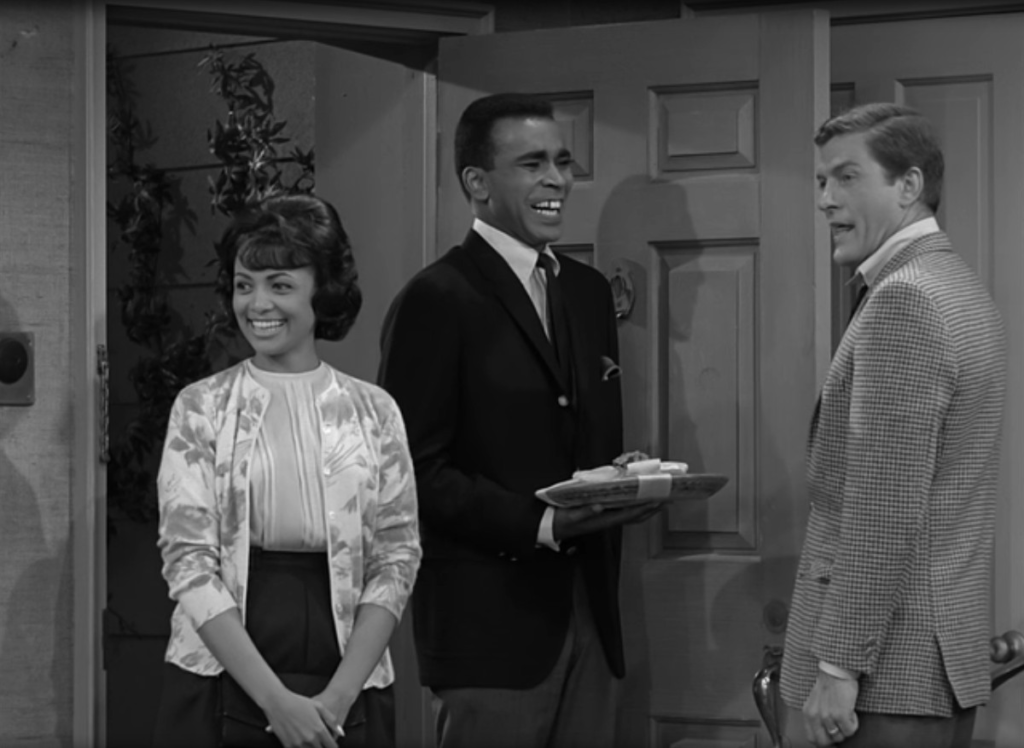
All of that was the setup for the comedic reveal that occurred when Mr. and Mrs. Peters walked through the door of the Petries’ home and the audience saw them for the first time. The stage directions in the script described that scene:
“A young, attractive Negro couple enter, carrying a basket of figs and smiling broadly. Rob stands, mouth agape.” 3
Studio Audience Gasped—Then Laughed, and Laughed!
When that 1963 studio audience saw an attractive African American couple come through the door, their reaction was everything the comedy writers could have hoped for. According to John Rich, who directed the show, the audience gasped, then they cheered and applauded.4
A review in the New York Times described the audience reaction this way:5
“So white was the Petries’ world that the moment when the Peterses walk through the door was a comic payoff that had been building not only for the whole episode but also for the life of the series.”
The revelation that Mr. and Mrs. Peters were Black got the biggest and longest studio audience laugh in the show’s history. Source: Video screen capture (Fair Use)
“It was the longest laugh I’ve ever experienced in my entire show business life. We just cut the cameras ‘cause they laughed and laughed and cheered. It was amazing.”
Dick Van Dyke
A High Point of Dick Van Dyke’s Career
Dick Van Dyke says it was a high point in his show business career.6
Viewers across the nation sitting in front of their television sets reacted much the same way. It was a great moment for both The Dick Van Dyke Show and for network television at a time, just a month after the 1963 March on Washington and Dr. Martin Luther King’s “I Have a Dream” speech, when the fight for racial equality and civil rights was at the forefront of the nation’s consciousness.
Producers Had to Fight to Air the Episode
One irony of that significant moment in American television history is that it almost didn’t happen. Executives at CBS, the network that carried The Dick Van Dyke Show, and at Proctor and Gamble, the sponsor, almost vetoed the idea because they were afraid that it might be considered racist or provoke unrest.
“Won’t people think we’re ridiculing the black couple?” one of them worried. But the show’s director, John Rich, recalls that Carl Reiner and Sheldon Leonard (the Executive Producer) were adamant:4
“Proctor & Gamble said we will not put this on. And CBS said we will not pay for this. God bless Carl and Sheldon. They said, ‘Look. We’ll do the show and if the audience tells us it’s bad taste, we’ll pay for it. If the audience accepts it, you pay for it.’”
Bill Persky, who co-wrote the script, says that Reiner told the network and the sponsor that he would quit the show if they didn’t broadcast this episode.6 And, Persky recalls, they never got one negative letter regarding the show after it aired.4
Rob Gets Final Word
At a time when school segregation was still a hotly contested issue in some parts of the country, the “That’s My Boy??” episode of The Dick Van Dyke Show tried to reinforce its message of racial equality in the final lines of the script.
In recounting the story of his baby-switch fiasco, Rob noted that not only did the Peters’ son, Jimmy, and the Petries’ son, Ritchie, attend the same school, but while Ritchie was at best an average student, Jimmy got straight A’s. In a final gag line, Rob laments, “I still think we got the wrong kid!”
Notes
Mr. Peters was played by Greg Morris, who is best known for playing electronics expert Barney Collier on Mission Impossible.
Mimi Dillard, who played Mrs. Peters, appeared in shows such as Arrest and Trial (1963), The Fugitive (1965), The Felony Squad (1966), A Man Called Dagger (1968), The Flying Nun (1969), and My Three Sons (1969-70).
The Dick Van Dyke Show featured African American comedian Godfrey Cambridge as a federal agent in an episode called “The Man from My Uncle” in 1966. When the show’s producer Carl Reiner was asked “Are there FBI agents that are black?” he replied, “There are now.” 2